The Order of Ushakov: Two Classes, the 1944 Statute and the Medal
What the two classes of the Order of Ushakov recognised, how their badges differed and why the Ushakov Medal was a separate decoration.
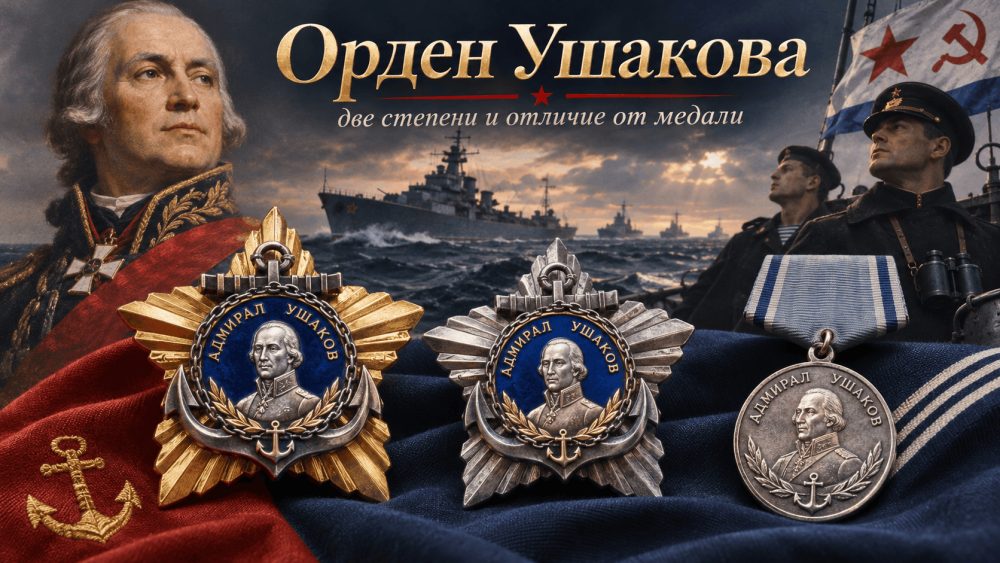
The Order of Ushakov was established on 3 March 1944 for Soviet naval officers whose achievements lay in organising and conducting maritime operations. It had two classes, with First Class the higher. The Order of Nakhimov was established at the same time, while a separate decree created medals bearing the admirals’ names.
A reference to an “Ushakov award” is therefore incomplete. The order and medal were distinct decorations, with different purposes and eligibility rules. Research into an individual’s service needs the exact name and class recorded in the award documents.
Why Ushakov’s name was chosen
Fyodor Ushakov belonged to the history of Russia’s sailing navy. The Central Naval Museum’s biographical note highlights his victories during the Russo-Turkish War of 1787-1791 and his command of a squadron in the Mediterranean in 1798-1800. His name connected a Soviet wartime decoration with an earlier naval tradition.
The order did not exist during Ushakov’s lifetime. It was a Soviet creation intended to recognise contemporary commanders. Distinguishing the historical figure portrayed on a badge from the date when that badge was established helps avoid a common misunderstanding in reading captions and family accounts.
Preparing the naval decorations
According to the Central Naval Museum, Navy Commissar Nikolay Kuznetsov proposed the Ushakov and Nakhimov orders in mid-1943. Captain First Rank Boris Khomich was given responsibility for organising their development. Specialists working under him included architect Mikhail Shepilevsky.
The award emerged from several kinds of work: an official decision, the formulation of eligibility rules and artistic design. The Victory Museum particularly identifies Shepilevsky as the designer of the Order of Ushakov. These accounts concern different contributions to the same process, rather than requiring every stage to be attributed to one person.
What First Class recognised
The statute centred on the achievement of a naval operation, rather than length of service or participation in the war alone. Grounds for First Class included:
- successful operations against enemy forces at sea and coastal installations;
- operations against enemy maritime communications;
- defeating superior forces while preserving the effectiveness of one’s own forces;
- a well-concealed major landing that achieved its objective with limited losses.
Planning, command and results were connected. In this context, “communications” meant the routes used by ships and transports. The provision concerned disrupting enemy movements and shipping, rather than simply making contact with an opposing force.
How Second Class differed
The Second Class provisions covered leadership in naval combat, raids on bases and coastal targets, and attacks on escorted warships and transports. They also addressed command of part of the forces involved in a major landing or the successful execution of a tactical landing.
Another provision concerned coordination among naval forces and means, while a further one recognised the organisation of operational support that produced major combat success. This last category is significant: the statute did not restrict command achievement to the person directing the immediate use of weapons.
The two classes should not be reduced to a simple list of ranks. Their provisions described actions and the scale of the task. Understanding a particular award requires its citation, not just the recipient’s job title.
Distinguishing the badges
Both classes placed the admiral’s portrait against blue enamel, surrounded by maritime elements including an anchor, chain and rope-shaped border. The First Class description specified a platinum star with gold details. Second Class used a gold star, with a silver portrait and inscription, and omitted the laurel and oak branches included in First Class.
These features help when comparing illustrations, but a photograph alone cannot authenticate a badge or establish its owner. Provenance depends on several kinds of evidence: its number, award documentation, service records and, where applicable, the museum’s collection history.
Early awards and the separate medal
The Victory Museum dates the first First Class awards to 16 May 1944. The recipients were Rear Admiral Pavel Boltunov and Lieutenant General of Aviation Vladimir Yermachenkov. The presence of an aviation commander among them illustrates the breadth of naval operations beyond surface ships alone.
Second Class awards began earlier. The museum records a group of Northern Fleet officers recognised on 10 April 1944. Any claim about the “first award” therefore needs to specify both the class and the date of the decision.
The Ushakov Medal was intended primarily for enlisted personnel and petty officers of the Navy who displayed personal courage. It was not the lowest class of the order. The order had two classes of its own; the medal was a separate decoration.
Three kinds of evidence work best together. The statute explains the grounds on which an award could be made. An award document explains an individual case. A museum description identifies the physical object. Confusing these levels can turn a general rule into an unsupported personal story, or an attractive picture into an unjustified claim that a particular person received the decoration.