Viktor Saneyev: Three Olympic Triple Jump Titles
How Saneyev won three consecutive Olympic titles: decisive attempts in Mexico City, Munich and Montreal, world records and Moscow silver.
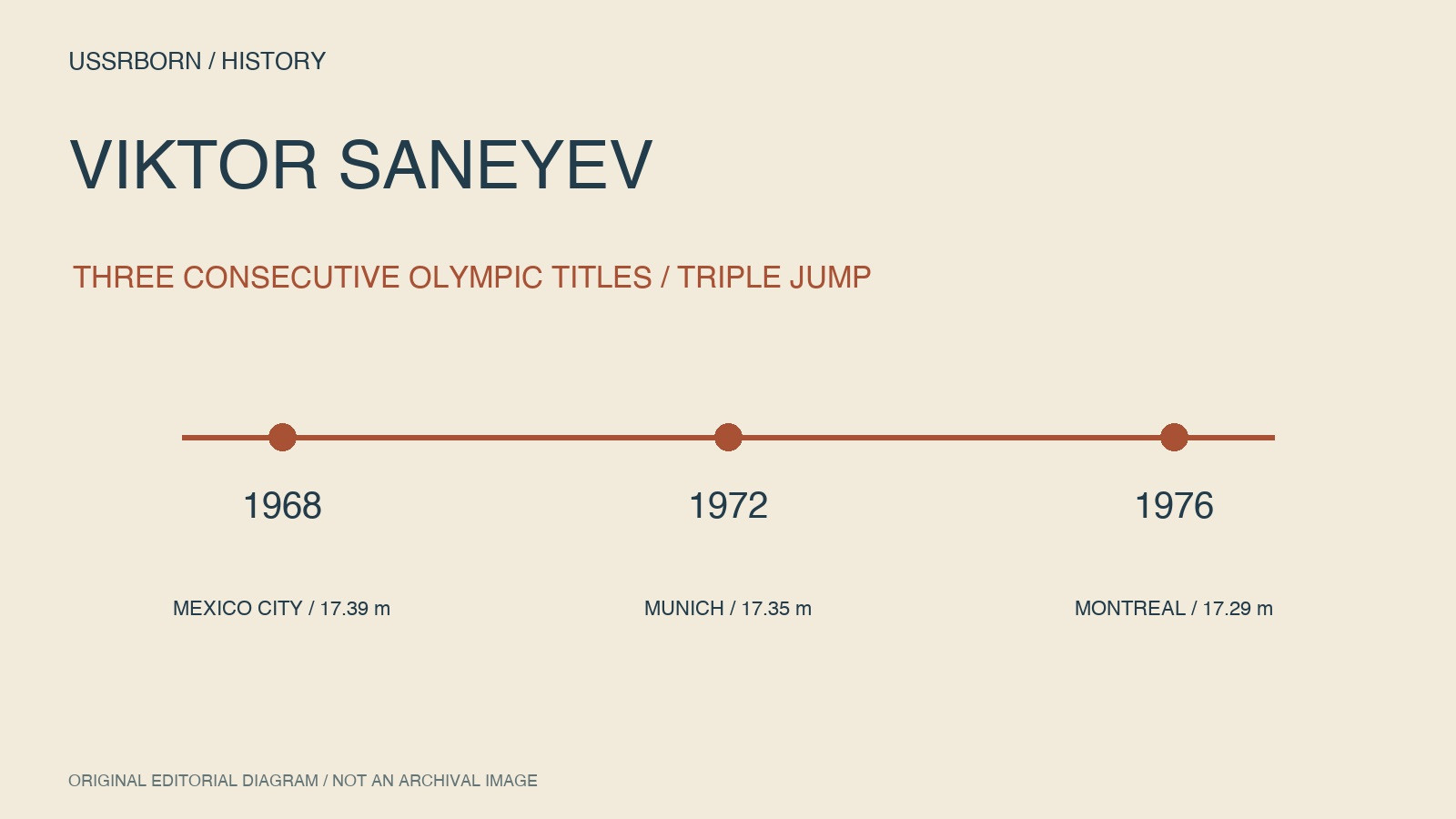
Viktor Saneyev won the Olympic triple jump at three consecutive Games: Mexico City in 1968, Munich in 1972 and Montreal in 1976. The sequence looks straightforward in a medal table. The competitions themselves were very different: a last-round world record, a first-round lead that survived, and a fifth-round recovery of first place.
A career beginning in Sukhumi
Born in Sukhumi on 3 October 1945, Saneyev took up athletics in 1956. He initially concentrated on the high jump. According to Olympedia's biography, a knee injury prompted his switch to the triple jump in 1963. He won his first Soviet championship in 1968, the year of his Olympic debut.
An athlete's best valid attempt determines a triple-jump result. The winning mark alone therefore leaves something out: when it happened. Setting a target at the start and having to beat someone with a final attempt are different competitive situations.
Mexico City: 17.39 metres at the last opportunity
The final on 17 October 1968 repeatedly moved the world record. Italy's Giuseppe Gentile had reached 17.10 metres in qualifying and improved to 17.22 in the final. Saneyev answered with 17.23 in round three. Then Brazil's Nelson Prudencio jumped 17.27 in round five.
Saneyev's sixth attempt measured 17.39 metres. It brought both the gold medal and another world record. Prudencio took silver and Gentile bronze. Saneyev had not simply protected an existing lead: he had to overtake a rival whose record was still fresh.
Munich: an opening jump that proved sufficient
On 4 September 1972 Saneyev began the final with 17.35 metres. East Germany's Joerg Drehmel came close with 17.31 but did not pass him. Prudencio finished third with 17.05.
The winning mark is recorded as wind-assisted beyond the limit for record recognition. It remained valid for the Olympic competition. This result should not be confused with Saneyev's 17.44-metre world record in Sukhumi later in 1972. The Olympic title and the record were separate achievements at separate meetings.
Montreal: taking back the lead
In the final on 30 July 1976, Saneyev moved ahead with 17.06 metres in round three. James Butts of the United States answered with 17.18 in round four. Saneyev then reached 17.29 in round five to secure his third consecutive gold. Brazil's Joao Carlos de Oliveira won bronze with 16.90.
The winning distance was shorter than Saneyev's Mexico City mark. That does not establish that the third title was easier. Olympic places are decided against the other athletes in that final; comparing maximum distances alone removes the sequence of challenges and responses.
Four Games and four medals
Saneyev added silver at Moscow in 1980, behind Soviet teammate Jaak Uudmae. His Olympic record thus ended with three gold medals and one silver.
Reading the three winning finals together gives the medal total a more concrete meaning. Mexico City required one final answer, Munich rewarded an opening advantage, and Montreal demanded a late recovery. The results record preserves those differences instead of reducing twelve years of Olympic competition to a single longest jump.