Mikhail Tal in 1960: Becoming Champion Against Botvinnik
How Tal qualified, what the score of 12½ to 8½ means and why the 1961 rematch did not erase his championship or define his entire career.
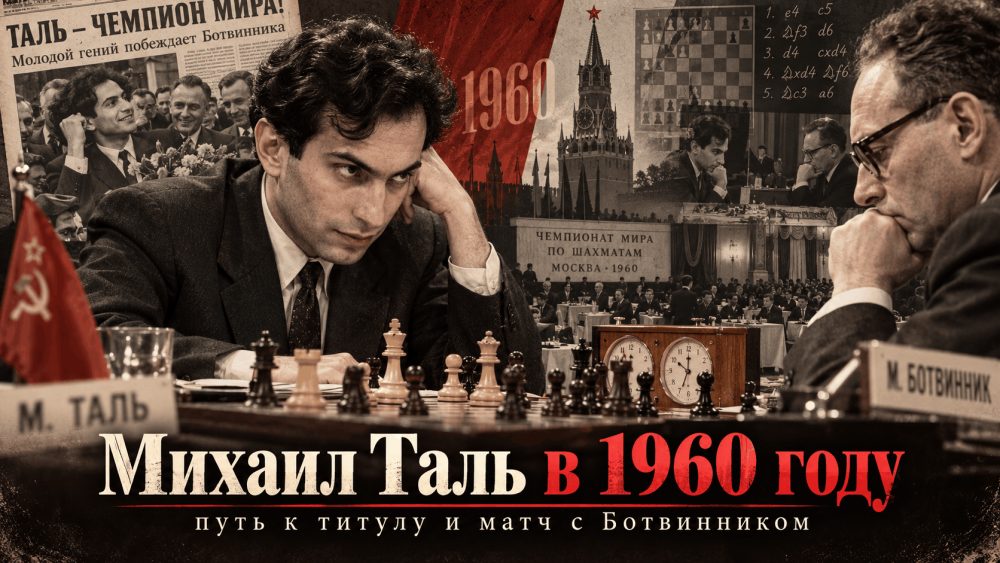
In 1960, Mikhail Tal defeated Mikhail Botvinnik in Moscow by 12½ points to 8½ and became the eighth world chess champion. Botvinnik regained the title in a rematch the following year. Those results define Tal's short reign, but they do not define the limits of his career.
Three events need to be kept separate: the Candidates Tournament of 1959, the world championship match of 1960 and the rematch of 1961. Winning the first earned Tal the right to play the second. Losing the third ended his reign without erasing the championship he had already won.
Becoming the challenger
The Chess Federation of Russia traces a sequence of successes: the Soviet championships of 1957 and 1958, the 1958 Interzonal and then the Candidates Tournament. A national championship and the international qualifying process were different competitions. Becoming Soviet champion did not automatically confer the right to challenge the world champion.
The 1959 Candidates took place in Yugoslavia. FIDE's historical account describes eight participants playing a quadruple round-robin. Each player met every opponent four times, making 28 games per participant. The event began in Bled, continued in Zagreb and ended in Belgrade.
This format tested sustained performance. A single excellent day could not settle the event, and a player could recover points against other opponents after a loss. Tal won the tournament even though his personal score against Paul Keres was 1-3. Winning the overall competition did not require winning every individual encounter within it.
That distinction is useful when comparing tournament records. A head-to-head result describes one part of the event; the final standings account for the whole field. Tal's qualification rested on the latter.
Reading the score of 12½ to 8½
The Moscow match ended with Tal four points ahead. The fractions reflect drawn games: a draw gives each player half a point, while a decisive game gives one point to the winner and none to the loser.
Adding 12½ and 8½ gives 21. The score therefore accounts for 21 games, rather than identifying how many games each player won. The final totals alone cannot reconstruct the sequence of results. For that, a game-by-game table is required.
This elementary distinction matters because short biographies often place points, wins and tournament places close together. They are different measurements. A four-point margin is not evidence that only four games were decisive.
A match also differs from a round-robin tournament. The same opponent returns repeatedly, learning about the player's choices and preparation. Success requires strong moves and adjustments to the other player's response over successive games. Tal won the title through this direct contest with the defending champion.
What lay behind the “Wizard from Riga”?
FIDE's museum associates Tal's nickname with combinations, sacrifices and the struggle for the initiative. Behind the memorable image lies a practical chess problem: possessing more material does not always mean having an easier position to play.
A player may surrender a pawn or piece to open lines, accelerate an attack or create difficult defensive decisions. The sacrifice alone does not prove that the idea works. The continuation determines whether the attacker has adequate compensation and whether the defender can neutralise it.
Calling Tal's play “hypnotic” should therefore remain a metaphor for its effect on spectators and opponents. It is not an explanation of how points were scored. Equally, the attractiveness of a combination does not establish that every variation was objectively flawless.
Three questions can be asked of the same game: was it beautiful, did it succeed in practice, and was a particular continuation the strongest available? Those questions need not produce identical answers. Keeping them separate makes Tal's attacking reputation more intelligible, rather than less impressive.
The rematch was another contest
Botvinnik won the 1961 rematch by 13 points to 8. Tal ceased to be the reigning champion but remained a former world champion. The sequence of victory, rematch and loss of the crown is more accurate than a story in which one brief triumph simply vanished.
The result should not be reduced to a single psychological trait. Biographical accounts offer interpretations involving confidence or preparation, but the score itself cannot establish one exclusive cause. It reliably identifies the winner of that particular contest.
Tal's later record also prevents his career from being confined to the championship year. FIDE's museum lists six Soviet championship titles and eight victories as a member of the Soviet team at Chess Olympiads. The latter are team achievements, not eight individual world championship titles.
There is consequently no contradiction between a short reign and a long elite career. Holding the world crown is one distinction within competitive chess; national titles, team performances and further attempts to qualify belong to other parts of the record.
A publication made for the match audience
The Russian State Library catalogues Mikhail Yudovich's Botvinnik-Tal: For the World Chess Championship Match. Published by the USSR Central Chess Club in 1960, it comprises 79 pages with illustrations and portraits.
The entry establishes that a dedicated publication was produced for the match's audience. Its subtitle does not establish that it contains a complete analysis of the finished contest. A catalogue identifies a source; the book itself would need to be examined to determine its arguments and coverage.
Tal's achievement in 1960 brought together a sustained qualifying campaign and an unusually recognisable way of playing. The competitive route explains how he earned his challenge, while the games explain the lasting fascination. Neither his preparation for the title nor the breadth of his career disappears because he held the crown for only a year.
Related articles
- Botvinnik and the 1948 championship
- The Soviet Olympic debut
- Lev Yashin and the Ballon d’Or
- Life in the USSR