Ivan Pavlov: A Nobel Prize for Digestion and His Soviet Years
Why Ivan Pavlov received the 1904 Nobel Prize, how digestion research led to conditioned reflexes and what his letters reveal about his Soviet years.
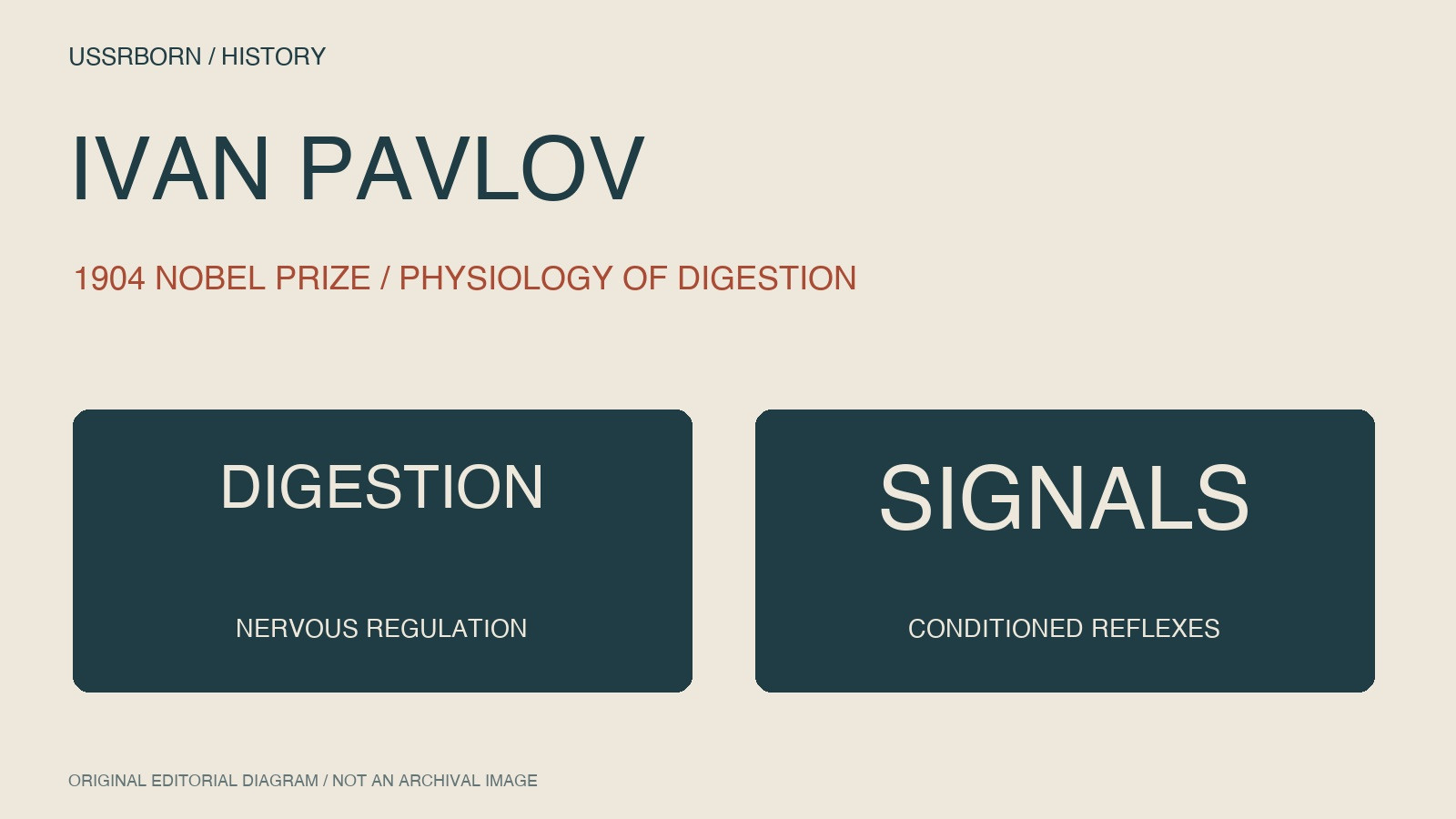
Ivan Pavlov received the 1904 Nobel Prize in Physiology or Medicine for his research on the physiology of digestion. His famous work on conditioned reflexes was connected with that research, but saying that he won the prize for a dog and a bell replaces the actual subject with a familiar symbol. To understand the achievement, it helps to ask the question behind the experiments: how does an organism regulate its digestive glands?
A career across two historical periods
Pavlov's scientific career began long before the USSR existed. His education took him from Ryazan and the natural sciences into medicine and experimental physiology. In 1890 he became professor of pharmacology at the Military Medical Academy; in 1895 he took its chair of physiology, which he held until 1925.
Much of his research on digestion during 1891 to 1900 was conducted at the Institute of Experimental Medicine. His lectures on the principal digestive glands were published in 1897. The chronology matters because the Nobel Prize recognised an established programme of investigation, rather than a single memorable demonstration.
Pavlov continued working in the country after the revolution. His biography therefore belongs to both prerevolutionary Russian science and Soviet scientific history. Calling the 1904 award a Soviet prize would be an anachronism. Treating his later decades as irrelevant would be equally misleading.
Observing an organism without losing the process
A physiologist's difficulty is not merely how to measure a secretion. The investigator must also consider how much the method of observation changes the process being measured. When an experiment seriously disrupts an organ's relationships with the rest of the body, its findings cannot simply be assumed to describe ordinary functioning.
Pavlov developed long-term, or chronic, experiments in which functions could be studied after an animal had recovered from surgery. Nervous regulation and the coordination of digestive activity were central to the programme. These investigations involved surgical intervention. Describing their methodological purpose should not turn into a claim that they were non-invasive or necessarily free of suffering.
In his Nobel lecture of 12 December 1904, Pavlov considered the different circumstances under which digestive juices were secreted. He examined the effects of food, nervous connections and circumstances associated with eating. An important distinction emerged between food entering the digestive system and the organism preparing for its arrival.
That distinction changes the experimental question. Rather than asking only what a digestive organ does after food reaches it, the researcher can ask how activity begins earlier, and which connections make that possible. The digestive system becomes a coordinated process to investigate, rather than a collection of isolated containers.
How a signal acquires significance
Pavlov described responses occurring before food entered the mouth. Why could an external feature begin to produce a reaction associated with food itself? In the lecture, he distinguished relatively constant, unconditioned responses from acquired responses dependent on previous combinations of stimuli.
A conditioned signal does not need to perform the biological function of food. Its significance develops through experience. Nor is the response fixed forever. Pavlov discussed how reactions weakened when a signal was repeated without the corresponding reinforcement, and the circumstances in which a response could return. This was an inquiry into changing relationships, rather than a story about an animal learning one permanent trick.
Two questions illustrate the difference. Did saliva appear? And under what conditions did it appear, following what sequence of events, with what degree of repeatability? The second question turns a striking observation into a research problem. It also permits an investigator to describe measurable relations without assuming that the animal reasons about the situation in human terms.
The familiar image of a bell can be useful as a first illustration, but it is inadequate as an account of the whole programme. The scientifically interesting element is the relationship between conditions, signals and responses. Replacing the instrument in a simplified example does not remove that underlying question.
Koltushi: a laboratory and its later memorial
Pavlov's Soviet years were closely associated with Koltushi. The Russian Academy of Sciences archive describes the building constructed between 1929 and 1933 that later became known as the Old Laboratory, and the scientific settlement that grew around it. In 1949, the centenary of Pavlov's birth, a study museum was opened there on Leon Orbeli's initiative.
It is useful to distinguish the laboratory of Pavlov's lifetime from the later exhibition commemorating it. A painting or diorama depicting the station in 1935 is a representation of the site, not automatically a photographic record of every detail. Buildings, objects and retrospective images answer different historical questions.
The history of laboratory work also offers a connection to other research programmes: Nikolai Vavilov's preservation of plant diversity, Pyotr Kapitsa's investigations of liquid helium and Nikolay Semenov's work on chain reactions. These were not versions of one universal experiment. Each required a way to organise observation and explain what the resulting evidence could support.
Support for science and disagreement with government
Correspondence published by the Pavlov museum in Ryazan complicates any picture of uncomplicated political loyalty. In a letter dated 21 December 1934, Pavlov sharply criticised violence and the political order. Molotov's reply of 2 January 1935 rejected his political conclusions while acknowledging his scientific standing.
A letter of 12 March 1935 is particularly revealing: Pavlov protested against the treatment of people around him and, in the same letter, thanked Molotov for supporting the work at Koltushi. Those two positions should be allowed to stand together. Assistance to a laboratory is not evidence that its director approved of the government's wider actions. The letters establish Pavlov's expressed views; they do not, by themselves, establish the eventual fate of everyone for whom he intervened.
What did the Nobel Prize recognise?
The precise short answer is research on the physiology of digestion. Conditioned-reflex research emerged from related questions about bodily regulation and developed into a major field in its own right. Distinguishing a prize's stated subject from the rest of a scientist's legacy is also useful when reading about other laureates, including Lev Landau.
Pavlov died in Leningrad on 27 February 1936. His career connects the development of experimental methods, the investigation of nervous regulation, the life of scientific institutions and a researcher's relationship with state power. The familiar dog in a simplified classroom story is an entry point into that history, but cannot adequately represent all of it.