Malevich and Black Square: Why There Are Several Versions
How Malevich returned to Black Square: the 1915 canvas, the 1929 version, differing museum dates and the development of the idea in his letters.
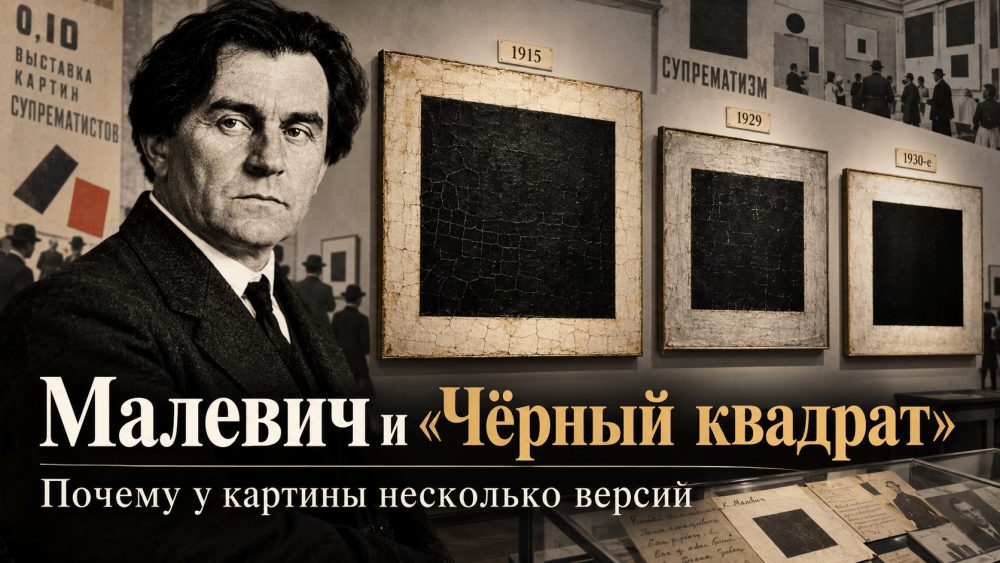
Kazimir Malevich is often reduced to the painter of a single image. Yet Black Square accompanied years of work: he returned to its composition, discussed its possibilities in letters and connected it with a broader search for an artistic language. Understanding that history requires a distinction between the idea, the canvas of 1915 and the later versions made by the artist.
The first painting predates the Soviet Union
The Tretyakov Gallery dates the original Black Suprematist Square to 1915, when it appeared at the 0.10 exhibition in Petrograd. It is a prerevolutionary work. Describing it as a painting first created in the USSR would confuse the chronology. Malevich's subsequent career, later versions and the work's museum history are the parts that extend into the Soviet period.
The original's collection record gives dimensions of 79.5 by 79.5 centimetres and records its transfer from the Museum of Painterly Culture in 1929. A date in an object's provenance is therefore not necessarily its creation date. The same year can have a different meaning in the record of another painting with the same title.
At the 0.10 exhibition, the square occupied a high corner position. The Russian Museum interprets the placement through the traditional icon corner. This helps explain the special status assigned to the image without requiring us to treat the painting as a literal religious icon.
An idea that continued to develop
Malevich's letters and theoretical writing make the square more than an isolated gesture. The Tretyakov Gallery's selection of his statements brings together reflections on form, non-objective art, white space and architecture. Read across several years, they reveal an ongoing investigation rather than a single slogan that explains everything.
A 1916 letter to Mikhail Matyushin described the square as an opening towards further possibilities. In correspondence with Mikhail Gershenzon in 1920, Malevich considered its development into architecture. The change of scale is revealing: a painted shape could become a starting point for thinking about an environment. These statements document the artist's thinking; they do not prescribe a single response that every viewer must experience.
Two levels are worth keeping apart. One is the physical painting, with its canvas, paint, dimensions and surface condition. The other is an idea that can be discussed, repeated and explored through different artistic tasks. Confusing them can make a later version appear to be a forgery, or lead to the opposite mistake of treating every version as the same physical object.
The distinct canvas of 1929
The Tretyakov Gallery has a separate record for Black Square of 1929. It describes the work as the artist's repetition of the 1915 composition, measures it at 80 by 80 centimetres and records its purchase from Malevich in 1934. It is a distinct object with a separate history.
It was made for Malevich's 1929 solo exhibition. The original remained a separate work with its own museum history.
A reproduction caption that supplies only the title Black Square withholds information essential to comparison. The year, collection and dimensions are useful minimum identifiers. Two pictures can be resized to identical dimensions on a screen without making the paintings they reproduce identical in scale or provenance.
Why catalogues mention both 1923 and 1924
The Russian Museum labels its canvas as dating from around 1923 and gives dimensions of 106 by 106 centimetres. The Tretyakov Gallery links the first repetition with the Venice Biennale of 1924. These descriptions should remain attributed to their respective museums rather than being silently replaced with a supposedly exact date.
A preparation date, an exhibition year and the date assigned in a museum catalogue are different kinds of information. In this case, preserving both formulations is more useful than concealing the variation. The word “around” also matters: it communicates the degree of precision in the collection record.
The broader lesson is practical. Before arguing about an apparent contradiction in art history, check whether two captions refer to the same object and whether their dates describe the same event. Acquisition, creation and exhibition can all generate prominent dates around a single title.
Malevich's Soviet career extended beyond the image
The Russian Museum records his foundation of UNOVIS in 1920 and his work at the State Institute of Artistic Culture in Leningrad during the 1920s. Teaching and theory formed part of his activity alongside painting. His Soviet biography consequently cannot be understood simply as the repeated production of one celebrated composition.
Related articles on Vkhutemas and the Melnikov House explore other efforts to rethink art, design and the built environment. They provide neighbouring contexts, not evidence that every participant shared Malevich's programme. The Soviet poster and Worker and Collective Farm Woman offer further comparisons in public visual culture.
Looking without a compulsory interpretation
First establish which version a reproduction shows. Then consider the relationship between the dark form and the light field, the edges, proportions and distance from the frame. These are suggestions for looking, rather than a claim to decode the artist's intentions once and for all.
The familiar objection that anyone could draw a square asks about manual replication. A different question asks what changes when a painting stops depicting a recognisable object. That question allows disagreement while taking the work's historical setting seriously. Museum records provide a factual foundation; they do not replace the viewer's experience.
Malevich's repeated engagement with the square is particularly useful here. The title names an image, but it also connects objects made at different moments and reflections that changed over time. Knowing which canvas is under discussion makes interpretation more precise and the artist's career less one-dimensional.