Worker and Kolkhoz Woman: From Paris to Mosfilm
Discover how Mukhina and Iofan shaped Worker and Kolkhoz Woman, why its setting changed and how the sculpture became Mosfilm’s recognisable emblem.
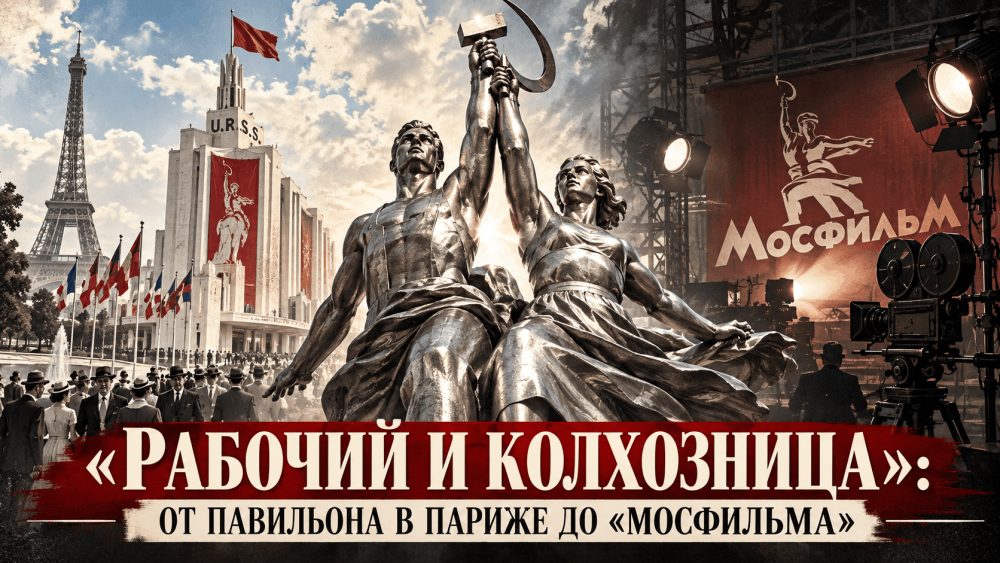
Worker and Kolkhoz Woman is familiar even to people who have never visited the monument. Some recognise a Moscow landmark; others remember the opening of a Mosfilm production. Yet the sculpture was originally made for a different setting: the Soviet pavilion at the 1937 international exhibition in Paris.
Its history becomes clearer when three things are separated: the architectural idea, Vera Mukhina's sculptural work and the composition's later life in Moscow and on film. A recognisable silhouette connects them, but each belongs to a different setting and serves a different purpose.
Why two names appear in the story
The idea of a sculptural group crowning the pavilion is associated with architect Boris Iofan. Vera Mukhina developed the sculpture itself. Asking who created the monument therefore requires a distinction between the architectural concept and the modelling of the figures.
The State Central Museum of Contemporary History of Russia makes these roles clear in its catalogue entry for a working model dated 1937. The word model is essential. Measurements given for that museum object should not be mistaken for the dimensions of the outdoor monument.
This is an easy error to make when a search result carries the famous title but omits the type of object being described. A model, a later copy and a monumental sculpture can share a name while having different dimensions, purposes and histories.
Architecture was not simply a support added after the artwork had been completed. The figures were intended to be seen above a building. The pavilion helped determine their scale, their visibility and the angle from which visitors encountered them.
What the figures represent
The worker and collective-farm woman move forward while raising a hammer and sickle. Implements of labour combine into a political emblem. The history of the hammer and sickle explains that emblem, while the sculpture gives it bodies, movement and three-dimensional form.
The figures function as generalised social types rather than portraits of two identified individuals. They present the idea of an alliance between industrial workers and the peasantry. This helps explain both the title and the work's public role.
An idealised image is not photographic evidence of everyday relations between the groups it depicts. The sculpture shows how society was being represented. Establishing what workers and collective farmers experienced requires other kinds of evidence.
That distinction does not make the artwork historically uninformative. It changes the question asked of it. Instead of expecting a monument to document ordinary life directly, a viewer can examine how it turns a political proposition into a visible and memorable composition.
Steel, structure and scale
The monument was made with a thin corrosion-resistant steel exterior supported by an internal frame. VDNH gives the height of the sculptural group itself as 24.5 metres. It was consequently not a single solid casting that could simply be placed on a pedestal.
The finished form conceals much of the work required to produce it. What appears to the viewer as one composition depended on the making and assembly of separate components. Its history therefore belongs to manufacture and engineering as well as to the artist's studio.
Scale changes the encounter. A small model can be examined near eye level; a group raised above a tall building is seen from below and at a distance. A close photograph may preserve details while removing the relationship between the artwork and the person looking up at it.
These are useful questions when comparing illustrations. Does the image show the whole architectural setting? Does it isolate the figures? Is it a photograph of the monument or of a model? Each can be accurate while conveying a different experience.
A new setting in Moscow
After Paris, the sculpture returned to the Soviet Union. In 1939 it was installed by the entrance to the All-Union Agricultural Exhibition, part of the subsequent history of VDNH. Its Parisian architectural surroundings did not accompany it unchanged.
Restoration took place between 2003 and 2009. The restored group was then mounted above a new pavilion broadly recalling Iofan's 1937 design. Its present setting should therefore not be described as an untouched prewar structure that has always stood exactly as it does now.
When photographs look different, the figures may not be the only explanation. The base, neighbouring buildings and camera position deserve attention too. Comparing those elements reveals the history of placement, even when the central silhouette remains familiar.
Becoming the Mosfilm emblem
The first screen appearance of the group as Mosfilm's emblem is associated with Grigory Alexandrov's 1947 film Spring. The studio's history explains that a special authorial copy by Mukhina was used. The outdoor Moscow monument itself did not have to be moved to the studio.
Mosfilm's later account also discusses copies and changes to the screen introduction. The monument, the studio model and the filmed image should consequently be treated as related objects, rather than as one physical object appearing in different places.
On screen, the composition performs an act of recognition. Before a story begins, viewers identify a studio. In a public space, it can become a destination to approach and examine. The history of Soviet cinema shows the wider context in which monumental art acquired this second kind of audience.
Looking beyond a familiar silhouette
Three questions offer a useful starting point: how is the composition organised, where was it meant to stand, and which version or setting are we looking at? They allow close attention without requiring an immediate verdict of admiration or rejection.
A comparison with Soviet posters suggests another question: how does public art make an image legible at a distance or during a brief glance? Sculpture adds volume and a changing viewpoint, so its experience cannot be exhausted by a flat outline on a screen.
The familiar emblem thus connects several histories: an exhibition project, a manufactured metal structure, a Moscow monument and a studio introduction. Keeping them distinct makes Mukhina's work easier to appreciate and explains how one composition could remain recognisable while moving between very different contexts.
Sources
- Museum of Contemporary History of Russia: the working model, for attribution and the distinction between model and monument.
- VDNH: the monument's creation and placement, for material, scale, installation and restoration.
- Mosfilm: studio history, for the emblem's appearance in 1947.
- Spring under the sign of Mosfilm, for the studio copy and the history of the screen introduction.
The cover is an original diagram of three stages in the work's history, not a photograph of the monument or a reproduction of Mukhina's sculpture.