Bread Ration Cards in 1935: Abolition, Prices and Daily Life
What changed on 1 January 1935, why unified prices varied between regions and which purchase limits remained after bread ration cards ended.
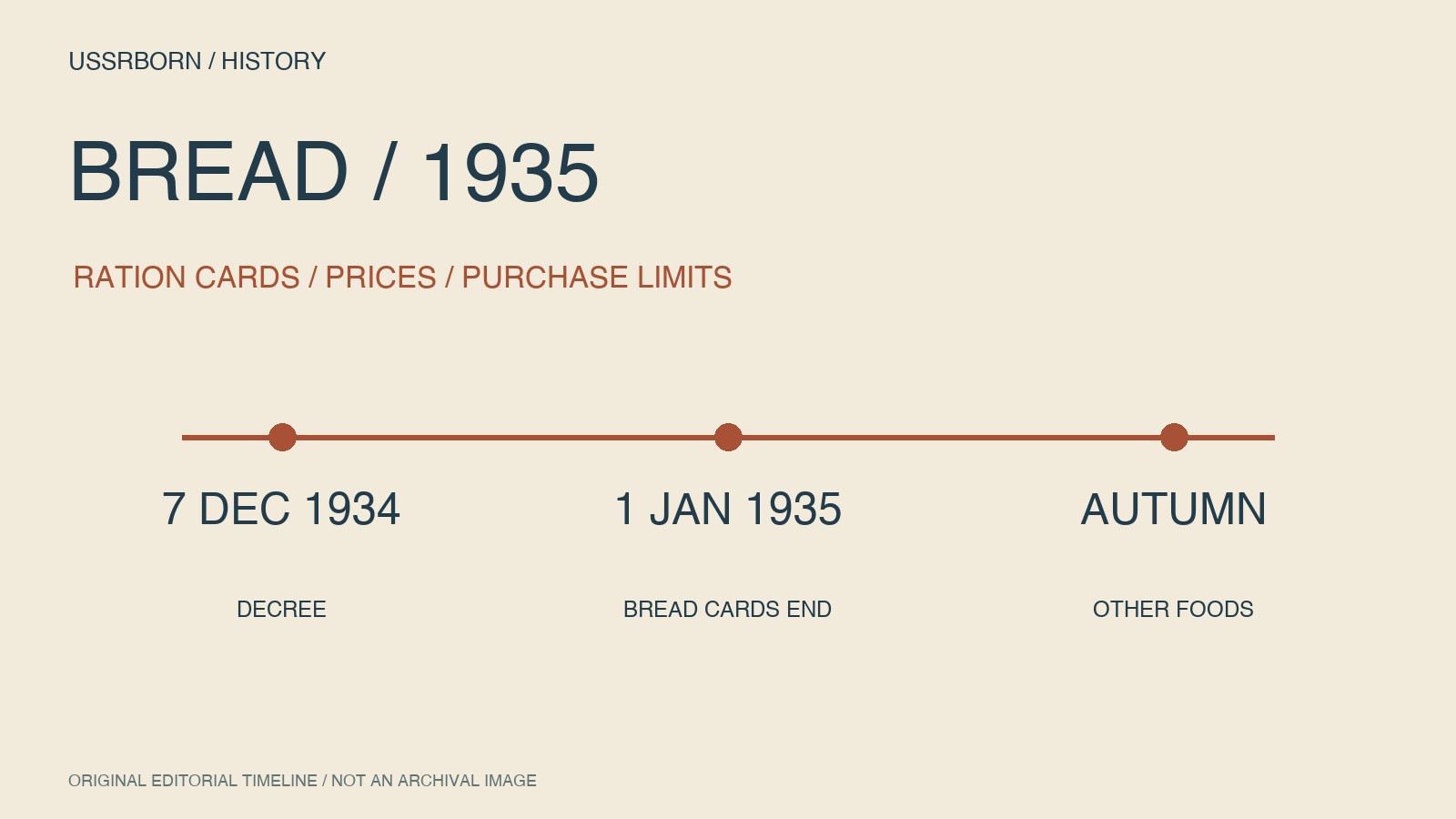
On 1 January 1935, the Soviet Union abolished ration cards for baked bread, flour and groats. The change altered how essential foods could be purchased, but it did not abolish every form of rationing at once or introduce freely determined market prices. New official prices, purchase limits and measures to compensate for higher expenditure accompanied the reform.
What the January measure covered
The governing decision was Council of People's Commissars decree No. 2684 of 7 December 1934. It ordered the expansion of sales of the specified foods through state and cooperative shops without the previous card system. Its provisions addressed prices, incomes, agricultural procurement and the organisation of retail trade.
Saying that ration cards ended in 1935 therefore requires a distinction between products. The January measure concerned bread, flour and groats. Meat, fish, sugar, fats and potatoes were addressed by a separate decision of 25 September, associated with a transition from 1 October. The two dates describe successive stages.
For a household, the distinction had practical consequences. Being able to buy bread without a card did not automatically establish the rules for buying meat or sugar. Reconstructing a family budget requires the month and the product as well as the year. A general date cannot supply all that information.
Uniform prices did not mean one price everywhere
The December decree replaced the combination of rationed and commercial prices with unified state retail prices organised into eight territorial zones. The word unified did not mean that every region and every kind of bread received an identical price.
A kilogram of rye bread made from 95 per cent extraction flour, for example, was priced at 80 kopecks in the first zone, one rouble in the third and one rouble fifty in the eighth. Moscow Region belonged to the third zone. The flour specification and the geographical zone were integral to the price, not optional details that can be dropped from a comparison.
Nor did the measure leave each shop to decide what to charge. The state prescribed the table. The reform changed access and the structure of prices within state and cooperative retailing while retaining official price regulation.
This matters when interpreting a remembered price. Two accounts can give different figures without either necessarily being mistaken. Before comparing them, the relevant questions are whether they refer to the same date, area, product and unit of weight. A price for a kilogram cannot simply be compared with an unspecified loaf.
Card-free purchasing still had a quantity limit
The decree temporarily limited sales to two kilograms of baked bread and one kilogram of flour per purchaser, irrespective of social position. It allowed up to two kilograms of flour in Sverdlovsk, Chelyabinsk and Ivanovo regions and Gorky Territory, citing insufficient development of bread production there.
The absence of a ration card and the absence of a quantity restriction were thus different conditions. A card system connected supply to an established entitlement. A limit per purchaser constrained a sale. Removing the first did not require abandoning the second.
The ceiling also should not be interpreted as a compulsory daily diet. The decree did not establish that every customer bought or consumed two kilograms of bread each day. It set a maximum quantity for sale, rather than measuring actual consumption.
That distinction prevents a misleading reconstruction of living standards. A legal purchase limit tells us about the rules at the counter. To know what people actually acquired, further evidence about spending, supply and household needs would be required.
Why compensation accompanied the change
The decree itself acknowledged that the new prices would exceed the previous rationed prices. It therefore provided for increases in workers' and employees' pay, student stipends and pensions during 1935 amounting to 4.2 billion roubles in total. Distribution was to take account of the advantages different groups had previously received under card-based supply.
This was an aggregate allocation, not an identical payment to each person. It cannot establish how a particular family's position changed. That calculation would require its earlier access to rationed goods, income, actual increase and pattern of purchases.
The consumer's experience consequently had more than one dimension. Removing a card requirement could widen access, while a higher price could raise expenditure. Evaluating the change means considering those effects together. The disappearance of a paper entitlement alone is not a complete measure of material wellbeing.
The autumn stage
The decision of 25 September combined lower bread prices with the removal of cards for the other named foods. The Electronic Library of Historical Documents identifies its publication in Pravda on 26 September. The Presidential Library also catalogues it within the official collection of laws issued in October 1935.
In a letter to Stalin dated 26 September, Lazar Kaganovich reported a favourable response from workers and employees. He also pointed to the need to improve shops and the organisation of selling. This records how a senior official presented the situation; it is not an independent measurement of opinion across the population.
The retail problem could not be solved by an announcement alone. New rules needed shops, deliveries and service to make them effective. Likewise, an official instruction to maintain continuous sales expresses a requirement placed on administrators. It does not, by itself, prove that queues were absent everywhere.
Understanding the reform at the shop counter
The 1935 changes moved major food categories from card-based allocation to open sale through state and cooperative shops at prescribed prices. The transition was staged, and regulatory limits remained.
Three linked questions provide a useful way to understand it: could the customer buy without the previous card, what price applied, and what compensation affected income? Together with the actual availability of goods, those factors determined what the reform meant in daily life.