Soviet Labour Reserves in 1940: Schools, Recruitment and Assigned Work
How trade, railway and FZO schools worked: admission ages, training periods, state support and the four-year obligation to take assigned employment.
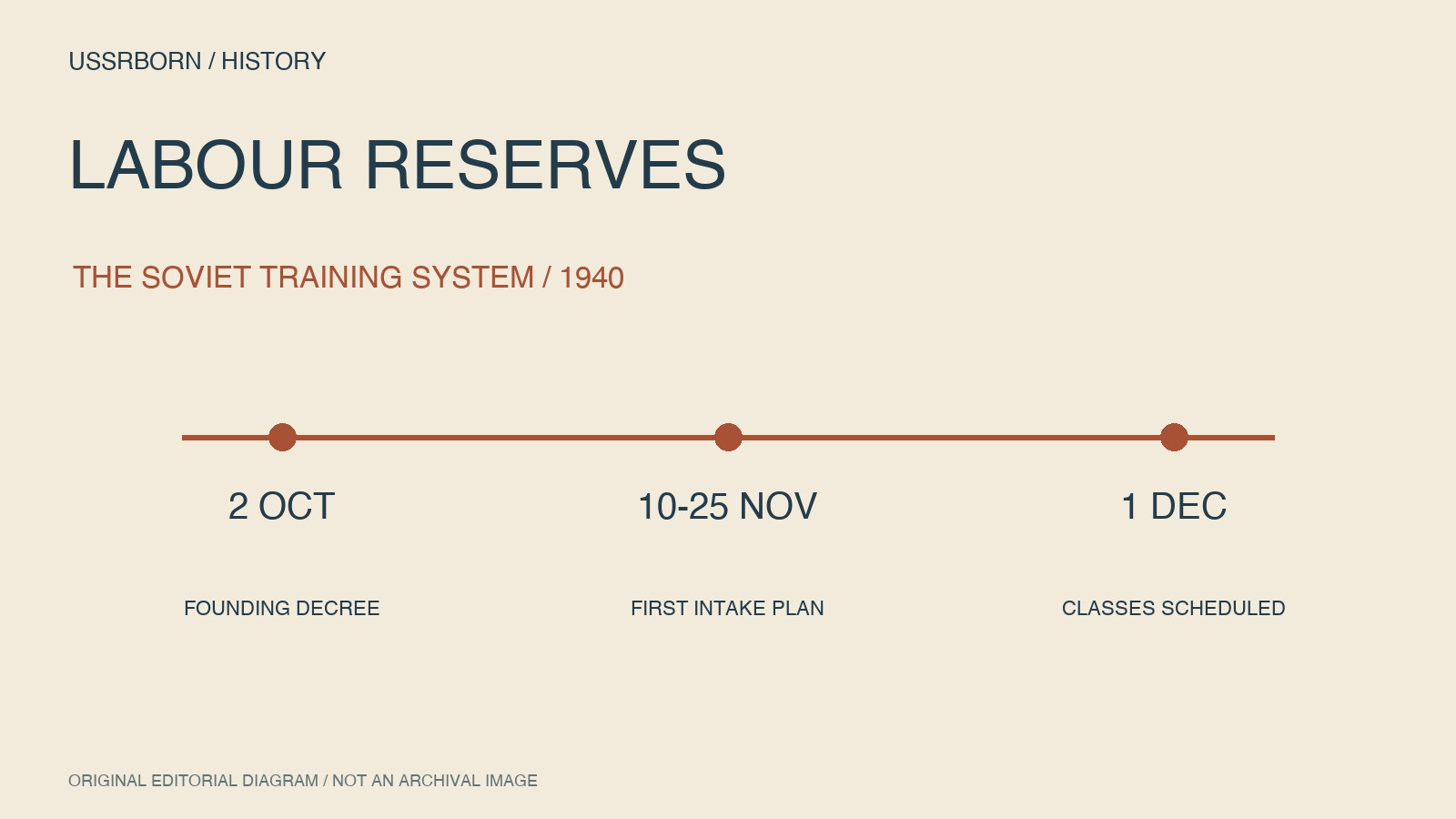
On 2 October 1940, the Soviet Union established the State Labour Reserves, a system for training young industrial and transport workers. It brought together trade schools, railway schools and factory training schools, commonly known by the Russian abbreviation FZO. The state paid for training and maintenance, while also acquiring powers to conscript teenagers and assign graduates to compulsory employment.
Those features need to be considered together. For a young person, entry could mean learning a trade, receiving meals and obtaining accommodation. It could also mean that officials, rather than the student, determined the course of education and employment. The founding documents describe both the provision and the restrictions.
A centrally managed supply of workers
The Presidium of the USSR Supreme Soviet linked the new system to the continuing need for workers in mines, factories, transport and other industries. The decree set an annual training objective of between 800,000 and one million people. This was a policy target, not evidence that precisely that many students graduated in each subsequent year.
The labour reserves were placed at the direct disposal of the Council of People's Commissars, or Sovnarkom. Individual commissariats and enterprises could not draw on them without government permission. The reform therefore involved more than opening schools. It created a central mechanism for preparing and allocating labour.
The decree's preamble claimed that poverty and destitution had disappeared. That assertion belongs to the document's political justification; it should not be treated as an independent measurement of living standards. The operative articles, specifying recruitment, training and employment obligations, provide a firmer basis for understanding how the system was intended to work.
Three different training routes
Trade schools were to offer two-year courses for complex industrial occupations. The decree named metalworking, metallurgy, chemicals, mining, oil, communications and maritime and river transport among the areas concerned. Railway schools also provided two-year training, including preparation for work as assistant locomotive drivers and railway repair workers.
FZO schools had a different purpose. Their initial six-month courses prepared workers for mass occupations, especially in coal, mining, metallurgy, oil and construction. A trade school and an FZO school were consequently not interchangeable names for the same programme.
Order No. 1 of the Main Administration of Labour Reserves, approved on 4 October, added admission requirements. Applicants to trade and railway schools needed at least primary-school education or completion of four school grades. FZO admission did not depend on the same general educational qualification.
The difference was substantial. Two years and six months represented different training commitments, and the occupations being taught were not identical. A later account that calls every institution simply a vocational school can obscure those distinctions.
The first recruitment campaign
The decree authorized the recruitment of urban and collective-farm boys aged 14 or 15 into trade and railway schools, and those aged 16 or 17 into FZO schools. These were the categories specified for conscription, not proof that no girls studied within the system. Separate provisions gave priority to male and female students transferring from factory apprenticeship schools being reorganized.
Sovnarkom Resolution No. 1852, also dated 2 October, scheduled the first intake for 10 to 25 November 1940. It set a target of 350,000 students for trade and railway schools and 250,000 for FZO, making 600,000 in total. That initial recruitment plan should be distinguished from the decree's broader annual training objective.
Recruitment could occur through conscription or voluntary enrolment. However, the October order explicitly placed volunteers under the same rights and obligations as those mobilized. Entering voluntarily did not remove the later duty to work where assigned.
Leaving home for a place in training
City and district commissions organized recruitment. Those called up were to receive a medical examination, a document directing them to a school and authorization for free railway travel. Collective farms were required to provide clothing, footwear, changes of linen, food for the journey and transport to the railway station.
These details show that the reform also organized movement between places. For a rural teenager, admission could mean leaving the family home and beginning life in accommodation attached to a school. The allocation of training places thus reached into households as well as industrial planning.
The implementing order specified state support, with somewhat different lists of provisions for the longer school programmes and FZO. Dormitory accommodation was provided for students from rural areas and other localities. Such clauses establish what an institution was supposed to supply. They cannot, on their own, prove how well every school fulfilled those obligations.
That distinction is useful when comparing a national decree with an individual memoir. The document records the formal entitlement; the memoir may describe the conditions actually experienced. One should not be used to erase the other.
A day divided between practical and classroom work
Trade and railway schools were assigned a seven-hour teaching day: five hours of vocational training and two for general and specialist subjects. FZO schools had an eight-hour day. The normal starting date was to be 1 September, but the first academic year was exceptionally scheduled to begin on 1 December 1940.
On completion, a student was to receive a certificate recording the test taken for a particular occupational grade. The intention was to certify a working qualification, not merely attendance at an institution.
The order also connected training with production. Schools could undertake elementary state orders, and it specified how income from such work was to be divided. Training was therefore organized around practical preparation for employment, although the existence of an official programme does not by itself tell us the quality of teaching in a particular workshop.
Four years of assigned employment
Article 10 required graduates of the schools to work for four consecutive years at state enterprises as directed by the Main Administration of Labour Reserves. They were to receive wages on the ordinary basis applicable at their place of employment. The obligation was therefore not a declaration that their work would be unpaid; it was a restriction on their freedom to choose where to work after training.
The system combined an opportunity to obtain a qualification with an administrative commitment of labour. Its original arrangements differ from the familiar idea of freely choosing a school and then independently seeking a job after graduation.
For family research, the exact institution and admission date matter. FZO, trade and railway schools had different programmes, and later rules should not automatically be applied to someone entering in 1940. The founding documents explain the initial structure. Certificates, assignment papers, correspondence and local records are needed to reconstruct how an individual moved through it.
Related articles
- The school reform of 1958
- The abolition of tuition fees
- Compulsory education in 1930
- The Soviet planned economy