Buran: Its Only Spaceflight and Why the Program Ended
Buran completed two orbits and an automatic landing on 15 November 1988. The flight succeeded, but the Soviet shuttle never entered regular service.
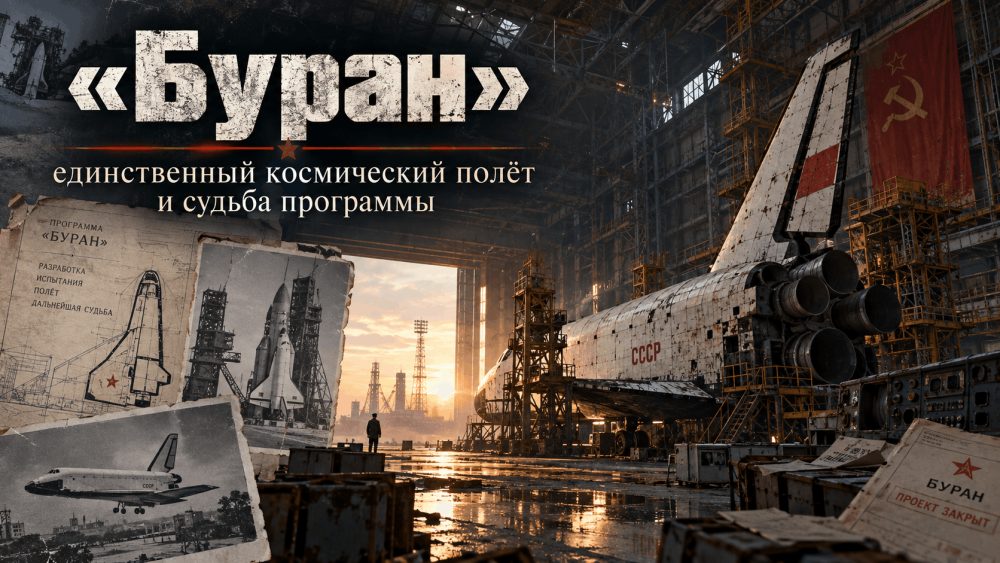
On 15 November 1988, Buran launched from Baikonur aboard the Energia rocket, completed two orbits of Earth and landed automatically on a runway. No cosmonauts were aboard. It remained the Soviet orbiter's only spaceflight.
Its resemblance to the American Space Shuttle made Buran one of the most recognizable vehicles of the late Soviet period. Yet photographs of two winged spacecraft explain only part of the story. Understanding the project requires separating the launcher, the orbiter, the landing system and the proposed operation of the transport system as a whole.
Energia and Buran had different jobs
Buran was the orbital vehicle. Energia was the rocket responsible for launching it. The distinction matters because the system was not simply an aircraft that could take off from a runway and fly into space.
The American Shuttle carried its main engines on the orbiter, drawing propellant from an external tank. In the Soviet arrangement, the principal launch propulsion belonged to Energia. The rocket was designed to carry payloads other than Buran as well.
That does not mean the orbiter had no propulsion of its own. Manoeuvring in space and preparing to return required onboard means of changing its motion. The useful comparison concerns what particular engines were intended to do, not whether an engine is visible in a photograph.
This division affected the whole program: which hardware returned, which elements had to be produced again and what the rocket could do independently of a winged spacecraft. Similar external shapes did not make the two transport systems identical.
Why build a winged orbiter?
A winged design allowed the returning vehicle to finish its flight on a runway. Before reaching that point, it had to survive atmospheric entry, lose most of its orbital speed and transition into a controlled descent.
This was not an ordinary airline flight. Orbital motion, reentry heating and a runway approach imposed different requirements on one vehicle. The ground organization also needed equipment for tracking, flight support and receiving the spacecraft after its return.
Within the Soviet space program, this represented a distinct transport approach. Mir was a place for extended work in orbit; Buran was designed to make journeys and return. Its sole 1988 flight did not dock with the station.
The distinction between a station and a transport is easy to lose when both appear in a general account of Soviet spaceflight. One provides the destination or workplace, while the other carries out a journey. Their success depends on different operating requirements.
The flight of 15 November 1988
The launch took place at Baikonur. After reaching orbit, Buran circled Earth twice, reentered the atmosphere and completed an automatic landing. The European Space Agency's historical description records the mission as an uncrewed flight with two orbits and an automated return.
There was no pilot inside who could intervene during the final approach. The flight tested a connected sequence of operations rather than an isolated landing manoeuvre: launch, orbital flight, return and touchdown all had to work together.
Automatic did not mean that people played no part. Preparing the flight program, calculating the trajectory, servicing the equipment and monitoring the mission were human tasks. The system executed its designed functions; it did not independently choose the purpose of the expedition or decide what research should be performed.
Completing that sequence was a significant engineering result. One test, however, could not demonstrate everything a future operational transport would need: repeated flights, crewed missions, different payloads and a dependable schedule remained separate questions.
A successful test and an operational service
A first flight demonstrates that a particular vehicle in a particular configuration has completed its assigned program. Routine service requires repeatability, preparation for subsequent launches, a continuing supply of components and a defined set of missions.
Reusability described the intended use of the orbiter. The single spaceflight did not itself demonstrate a second launch of the same vehicle. This matters when discussing economics. Bringing a structure back is only one part of the cost calculation; servicing, replacement hardware and the number of actual flights also matter.
It would therefore be a mistake to infer from the landing that the system was ready to replace every other kind of rocket. It would also be wrong to label the flight unsuccessful simply because the program never reached regular operations. The outcome of a test and the long-term outcome of a program need different evidence.
The same distinction applies to comparisons with the American Shuttle. A visual resemblance or a single successful manoeuvre cannot by itself establish that one entire program was cheaper, safer or more capable across all proposed missions.
Why was there no second spaceflight?
Buran reached orbital testing near the end of the Soviet Union. Economic constraints and changing political priorities complicated further development. After the dissolution of the USSR, sustaining such a large system of development, production and operations became still more difficult.
Funding and the purpose of the program remained issues alongside technical readiness. An automatic landing did not answer the question of which payloads would fly during subsequent years or how often the system would be used. For a major transport project, an uncertain mission schedule was a problem in its own right.
The comparative study Birds of a Feather describes the termination as a process extending through 1993 and 1994, including cancellation, mothballing and the withdrawal of support for active storage. The commonly cited cancellation year of 1993 is therefore a useful marker, not evidence that every activity and facility disappeared on a single date.
No one factor needs to be turned into a complete explanation. A successful test could coexist with unresolved operational questions, a changing strategic environment and insufficient support for continuing a costly program.
A museum Buran may be a different vehicle
The program used several kinds of test hardware. Technik Museum Speyer identifies its OK-GLI exhibit as an atmospheric flight-test prototype that completed 25 test flights. It is not the same vehicle that made the two orbital revolutions in November 1988.
This distinction also matters when reading image captions. An orbital vehicle, an atmospheric analogue and a ground-test article can look similar while serving different purposes. Atmospheric test flights should not be added to the total of orbital missions.
The history of Apollo-Soyuz offers a broader reminder that spacecraft are built around particular tasks. An international docking demonstration required one combination of vehicles and procedures; a reusable transport demanded another. Buran should be assessed against its own program rather than credited with missions that other spacecraft performed or plans that were never flown.
Frequently asked questions
How many times did Buran fly in space? Once, on 15 November 1988. Flights by atmospheric test vehicles belong to a separate category.
Who piloted the landing? An automatic system carried out the landing. There was no crew aboard.
Was it an exact copy of the Space Shuttle? The resemblance was strong, but the launch architecture and the distribution of functions between rocket and orbiter differed.
Why is it called reusable? That was the intended role of the orbital vehicle. A repeat spaceflight did not take place in practice.
Sources
- ESA: Buran's only orbital flight.
- NASA: Exploring the Unknown, Volume IV, Developing the Space Shuttle.
- Birds of a Feather: comparison of the shuttle programs and their outcomes.
- Technik Museum Speyer: the OK-GLI test vehicle.
Cover: original USSRborn editorial infographic showing the flight's stages. It is not an archival photograph of the spacecraft.