Salyut 1: The First Space Station and Its Only Resident Crew
Launched in 1971, Salyut 1 introduced life and research aboard an orbital station. Its only resident crew made history before the tragedy of Soyuz 11.
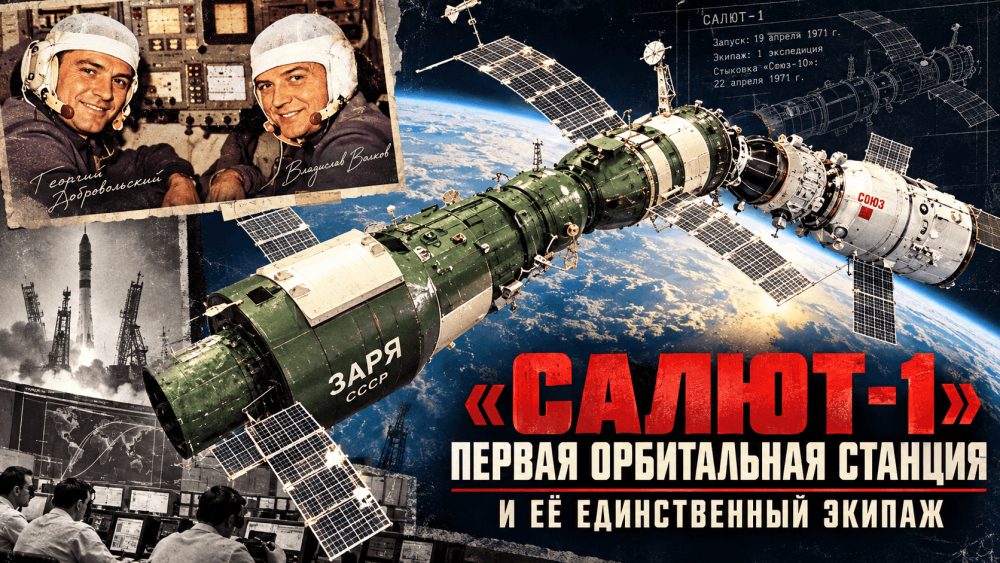
On 19 April 1971, the Soviet Union launched Salyut 1, the world's first space station. In June, Georgi Dobrovolsky, Vladislav Volkov and Viktor Patsayev entered it and began an expedition lasting more than three weeks. They later died while returning to Earth aboard Soyuz 11.
The story contains two distinct events: successful work aboard the first inhabited orbital laboratory, and a fatal accident in its transport spacecraft after departure. Both belong to the mission's history, but the crew did not die inside Salyut 1. Keeping the location and sequence clear is essential to understanding what happened.
What made a station different from a spacecraft?
A crew transport carries people to orbit and brings them home. A station remains in space, providing a larger place to live and work. For Salyut 1, those functions were divided between the orbital laboratory and the smaller Soyuz attached to it during the expedition.
This arrangement made more room available for experiments, exercise, food and rest. It also introduced a critical requirement: the arriving crew needed a sealed passage between two independently launched vehicles. A fault in the docking mechanism could make a laboratory inaccessible even though it was already operating in orbit.
After early crewed flights and Alexei Leonov's spacewalk, another practical question remained: how should people organize weeks of work beyond Earth? Salyut 1 was an early attempt to answer that question through an actual expedition rather than a design proposal.
The station's mixed technical origins
Salyut 1 combined a structure developed for the military Almaz program with systems derived from Soyuz. The resulting station served as a civilian scientific laboratory. This history also explains why the name Salyut should not be treated as proof that every station in the series had the same purpose or design lineage.
A Proton rocket placed the station in orbit. It had one docking port, a significant limitation compared with later complexes that could accommodate additional spacecraft or modules.
The consequence was straightforward. When the crew's return spacecraft occupied that port, another vehicle could not use the same connection. Building a more capable station would eventually require solutions for cargo delivery, crew replacement and access to additional modules, as well as more room inside.
The first station was thus a working experiment in orbital habitation, not a smaller version of a fully developed modern outpost. Its layout and operations reflected the capabilities available at that stage of the program.
Why Soyuz 10's crew could not enter
Soyuz 10 made the first crewed attempt to visit Salyut 1 in April 1971. Its cosmonauts reached the station, but trouble with the docking mechanism prevented a usable connection for crew transfer. They returned to Earth without beginning work inside the laboratory.
Rendezvous, initial mechanical contact and a sealed docking are different stages. Meeting another spacecraft does not by itself allow people to open a hatch. The connection must be mechanically secure and provide a safe passage between the pressurized interiors.
Engineers subsequently modified the docking equipment and revised the procedures. Soyuz 10's experience explains the gap between the station's launch date and the arrival of its first residents. A station can be in orbit without being accessible to the crew sent to use it.
The only resident crew
Soyuz 11 launched on 6 June. The following day it docked with Salyut 1, allowing Dobrovolsky, Volkov and Patsayev to enter. They became the first people to live aboard a space station.
Starting the expedition involved checking equipment and addressing malfunctions. Once operations were established, the crew conducted medical studies, exercised and carried out scientific observations. Patsayev worked with the Orion-1 ultraviolet telescope, and the station also supported plant experiments.
Long-duration life in space was itself part of the research. How would the crew's condition change? How should sleep be organized? How much time would equipment maintenance and exercise require? An inhabited station made these questions part of daily practice rather than matters assessed only after a short flight.
NASA's account describes an initial shift arrangement that kept at least one cosmonaut awake. Researchers later concluded that the round-the-clock approach disrupted sleep and reduced performance. Keeping every hour occupied was not necessarily the best way to obtain useful work.
That was a lesson about station design in a broad sense. An expedition depends on a workable routine as well as hardware. Time for rest, maintenance and exercise cannot simply be removed to increase the apparent number of research hours.
The Soyuz 11 accident
Near the end of June, the crew prepared Salyut 1 for uncrewed operations and returned to Soyuz. After departure and the braking manoeuvre, the spacecraft began the sequence that would bring its descent capsule back to Earth.
During separation of the spacecraft's sections, a valve opened prematurely. Air escaped from the descent module into space. The cosmonauts were not wearing pressure suits, and the rapid loss of cabin pressure killed all three before landing. The automated descent continued and brought the capsule to the ground.
The tragedy is usually dated 30 June 1971. Chronologies expressed in Universal Time can list the end of the flight on 29 June because of the time-zone difference. These dates do not describe two separate accidents.
The loss led to changes in spacecraft design and flight procedures. Pressure suits became a requirement for subsequent Soyuz launches and landings. The lesson concerned protection throughout the mission: weeks of successful station operations did not remove the danger of a brief event during the return journey.
What happened to Salyut 1 afterward?
The station remained in orbit without a crew after Soyuz 11 departed. No second long-duration expedition occupied it. On 11 October 1971, it was brought out of orbit and its existence ended during atmospheric reentry.
Its influence extended beyond being first. Later stations developed improved arrangements for resupply and extended expeditions. Mir eventually developed the concept of a complex assembled from multiple modules. The Apollo-Soyuz mission illustrated another use of docking: connecting spacecraft operated by two countries.
Within the wider history of Soviet spaceflight, Salyut 1 marked the arrival of an orbital laboratory as a place for sustained work during an expedition. It did not yet establish uninterrupted human occupation of orbit or a mature system of regular cargo deliveries.
Frequently asked questions
When was the first space station launched? Salyut 1 launched on 19 April 1971 without a crew aboard. Its residents arrived in a separate spacecraft.
How many crews worked inside it? One: Dobrovolsky, Volkov and Patsayev from Soyuz 11. The earlier Soyuz 10 crew could not enter.
Did the cosmonauts die on the station? No. The fatal depressurization took place in Soyuz 11's descent module during the return to Earth.
Did the station land intact? No. Soyuz was the crew's return vehicle. Salyut 1 itself was deorbited and destroyed during atmospheric reentry.
Sources
- NASA: launching the world's first space station.
- NASA: the Soyuz 11 crew's work and loss.
- David S. F. Portree, Mir Hardware Heritage, sections 1.7 and 2.2.
- NASA: a discussion of early space stations.
Cover: original USSRborn editorial infographic showing three dates in the station's history. The orbital line is schematic; this is not an archival image of Salyut 1.