The subbotnik: how a country cleaned up for free and almost willingly
Fifteen workers repairing locomotives for free at night, a log on the leader's shoulder, and a whole country with rakes every spring. The story of a ritual that began as a sincere impulse and ended as a compulsory day off with a broom.
What a subbotnik is
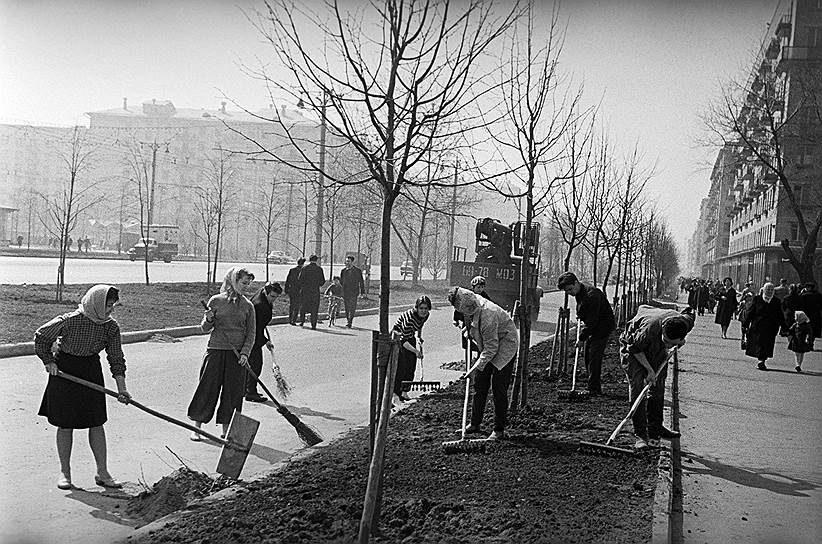
A subbotnik is a day of free, voluntary labor for the common good, usually on a day off. The name comes from subbota, Saturday, on which the first such days were held; there was also a voskresnik, from voskresenye, Sunday. Over seventy years the subbotnik traveled from revolutionary enthusiasm to routine ritual: first it was a sincere impulse of workers, then an almost obligatory event to which whole enterprises turned out to clear grounds, plant trees and sweep the streets.
The word proved remarkably durable. "Subbotnik" is understood across the whole post-Soviet space and has entered other languages as a term for collective unpaid cleanup. And to this day, in spring, people come out to tidy their courtyards, often without even remembering that they are repeating a ritual more than a hundred years old.
The night of April 12, 1919
It all began at the height of the Civil War, and it began sincerely. On the night of Saturday, April 12, 1919, fifteen workers of the Moscow-Sortirovochnaya depot of the Moscow-Kazan Railway, having finished their shift, did not go home. The country was choking for want of working locomotives, the front needed transport, and the depot's communists decided to stay and work for free. In ten hours, until six in the morning, they repaired three locomotives, drank some tea, agreed to repeat this every Saturday, sang the Internationale and went home. So, without ceremony, the genre was born.
The initiative was taken up. On May 10, 1919, the first mass subbotnik was held on the same railway: more than two hundred people, with labor productivity nearly three times the usual. Days of free work rolled across the country: repairing, loading, unloading, helping the front. It was a rare moment when the enthusiasm was genuine: people believed they were building a new world with their own hands, and unpaid labor held a meaning for them that it would later lose.
"A Great Beginning" and Lenin's log
Lenin noticed the phenomenon. In the summer of 1919 he wrote the article "A Great Beginning," declaring the subbotniks the shoots of a new, communist attitude to labor and giving them a significance he compared to historic victories at the front. From that moment a spontaneous impulse became a state affair.
On May 1, 1920, by decision of the party congress, the first all-Russian subbotnik was held, and Lenin himself took part. On the grounds of the Kremlin he cleared building rubble along with the others, and this episode gave rise to one of the most reproduced images of Soviet propaganda: Lenin carrying a log. The artist Vladimir Krikhatsky later painted "Lenin at the First Subbotnik," showing the leader striding with a log on his shoulder, and this scene was reproduced for decades on posters, in textbooks and on postcards as proof of the leader's closeness to ordinary labor. A real log turned into a symbol, and the symbol into an obligatory element of the cult.
Voluntary and compulsory at once
Then came what came to all Soviet impulses: the sincere was made obligatory. By Brezhnev's time the subbotnik had long ceased to be spontaneous. It was appointed from above, orders were issued about it, and one could be reprimanded for not showing up. Once a year, in April, near Lenin's birthday, the "all-Union Leninist communist subbotnik" was held, and the whole country dutifully came out to work on a day off. The Komsomol was responsible for the attendance of the young, the trade union committee for the rest.
The people answered this in their signature way, with irony. Officially the subbotnik was a festival of labor; unofficially it was a pretext to gather, stretch one's legs outdoors and sometimes simply mark the spring in the company of colleagues. Work varied: in some places order was really put in, in others busy activity was imitated and people left early. The formula "voluntary and compulsory at once," coined by the people about precisely such events, described the subbotnik more accurately than any slogan. Of the ideal of selfless labor that had inspired the record-setting Stakhanovites, a compulsory chore with rakes remained, but even it had a living, human side.
What it really was
An honest look at the subbotnik, as always in this history, is double. On one side stands the sincere idealism of the early years: people really did repair locomotives for free because they believed in a common cause, and that was not propaganda but an impulse. On the other stands the years of official obligation into which that impulse degenerated: labor called voluntary that could not be avoided. Both sides are real, and one grew out of the other, which is the main plot.
The subbotnik also had a practical use that it would be foolish to deny: by spring the cities really did become cleaner, trees really were planted, courtyards were put in order. Millions of people came out together, and in that shared labor, even when coerced, there was something many recall warmly: a common task, the spring, a sense of shoulder-to-shoulder. The subbotnik was at once a compulsion and one of the few forms of togetherness available to the Soviet person, and the two cannot always be separated.
The legacy
The subbotnik outlived the USSR as calmly as the cult around it disappeared with the country. The ideology was taken out of it and the habit left in: in many post-Soviet countries spring subbotniks are still held, in schools, courtyards, parks and embankments. Only now people come out not for communism but for a clean courtyard, and no one forces them. The result is what the subbotnik had been on its very first night in 1919, before any propaganda: people, of their own will, doing a common task together. The circle has closed, and it is perhaps the most peaceful ending of all those that fell to Soviet rituals.
Frequently asked questions
What is a subbotnik, in simple terms? A day of voluntary unpaid labor for the common good, usually on a day off: cleaning, planting trees, repairs. The name comes from subbota, Saturday, when the first such days were held.
When and where was the first subbotnik? On the night of April 12, 1919, at the Moscow-Sortirovochnaya depot of the Moscow-Kazan Railway: fifteen workers repaired three locomotives for free. On May 10, 1919, the first mass subbotnik was held there.
Why is the subbotnik linked to Lenin? Lenin praised the subbotniks in the article "A Great Beginning" (1919) as a model of a new attitude to labor, and on May 1, 1920, he personally took part in the all-Russian subbotnik in the Kremlin. Hence the famous image of Lenin with a log.
Did Lenin really carry a log? Yes, at the subbotnik of May 1, 1920, he cleared rubble in the Kremlin along with others. The episode became a symbol and the basis for the painting "Lenin at the First Subbotnik" and countless posters.
Were subbotniks voluntary? At first yes, it was a sincere impulse. Later they became effectively compulsory: attendance was appointed from above and absence could be punished. The people called this "voluntary and compulsory at once."
Are subbotniks held today? Yes, in many post-Soviet countries the tradition of a collective spring cleanup of courtyards, parks and streets survives, but now without ideology or compulsion.
Related
- Vladimir Lenin: the author of "A Great Beginning" and the man with the log.
- The Komsomol: the organization responsible for turnout at subbotniks.
- The Stakhanovites: the same labor ideal pushed to a record.
- The October Revolution of 1917: the event that bred the enthusiasm of the first subbotniks.
Sources
The facts in this article can be verified against authoritative sources:
- Encyclopedia.com (Encyclopedia of Russian History), "Subbotnik": https://www.encyclopedia.com/history/encyclopedias-almanacs-transcripts-and-maps/subbotnik
- Wikipedia, "Subbotnik": https://en.wikipedia.org/wiki/Subbotnik
- Russiapedia (RT), "Of Russian origin: Subbotnik": https://russiapedia.rt.com/of-russian-origin/subbotnik/
- Russian Life, "Subbotniks: Soviet 'Days of Service'": https://www.russianlife.com/stories/online/subbotniks-soviet-days-of-service/
- V. I. Lenin, "A Great Beginning" (1919), Marxists Internet Archive: https://www.marxists.org/archive/lenin/works/1919/jun/19.htm
The subbotnik's double nature (a sincere impulse and the later obligation) is stated directly, from historical and reference sources.